7 Critical Breast Cancer Symptoms in Women to Know in 2026 (and What to Do Next)
Written by Dr. Hemant Kadam, BAMS | Medically reviewed by Dr. Farah Zariwala, BHMS | Last updated: 20 November 2026
This article is for education only. It does not replace an examination or diagnosis by a qualified doctor.
Breast cancer is the most common cancer among women in India, with an estimated 192,020 new cases in 2022 (IARC GLOBOCAN via WHO, 2024). Knowing the breast cancer symptoms in women helps you act sooner. Earlier-stage disease is generally easier to manage.
Many women feel a change and wait. A lump that does not hurt seems harmless. A small skin change looks like a rash. Busy schedules, family duties and fear of a diagnosis all add to the delay. That hesitation is human, and it is very common.
In this guide, you will discover the seven main warning signs, the non-cancerous causes of a breast lump, what a mammography test costs in Mumbai, how stage 2 survival is reported, and what the treatment path looks like. You will get all of it without jargon or fear-based claims.
Dr. Hemant Kadam, BAMS, wrote this guide. Dr. Farah Zariwala, a BHMS with more than 10 years of experience in Ayurveda and Homeopathy, reviewed it. Health Reactive has supported more than 1,00,000 patients over 30 years.
Key Takeaways
- The most common sign is a new, hard, painless lump, but skin, nipple and underarm changes also count.
- Most breast lumps are not cancer. Every new lump still needs a clinical exam and imaging.
- Only a biopsy can confirm breast cancer.
- Published Mumbai mammogram prices range from roughly ₹1,000 to ₹3,500 at many centres, and vary by test type.
- SEER has no single stage 2 figure. US five-year relative survival is 100% for localized and 87.2% for regional disease.
- Supportive care can run alongside treatment. It never replaces your oncologist’s plan.
What Are the Breast Cancer Symptoms in Women?
Breast cancer symptoms in women range from a new lump to subtle changes in the skin or nipple. Some women notice nothing at all, which is why screening matters. The American Cancer Society (ACS) and the Mayo Clinic describe the same core signs. Each sign can also have a non-cancerous cause, so only a clinician can tell the difference.
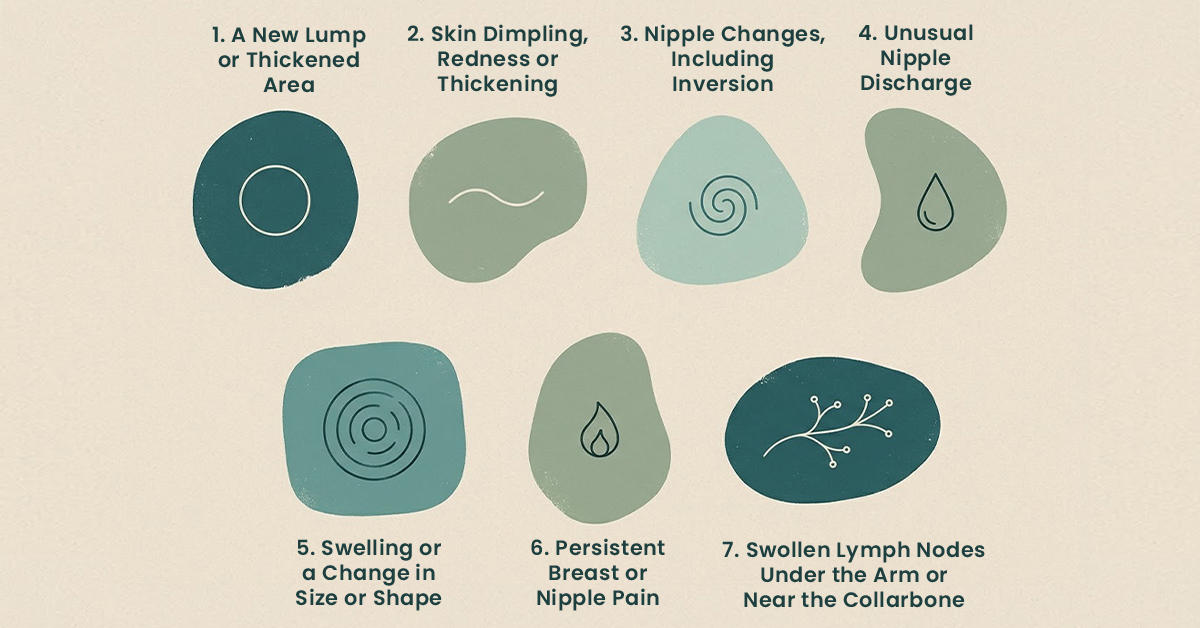
Seven changes are the main breast cancer symptoms in women. They are a new lump, skin dimpling, nipple inversion, nipple discharge, breast swelling, persistent pain and swollen underarm glands. A new, hard, painless lump is the most common sign. Many of these signs have non-cancerous causes, so a doctor must confirm the cause.
The ACS states that a new lump or mass is the most common symptom of breast cancer, although most breast lumps are not cancer (ACS, 2025). The sections below explain each sign in plain language.
1. A New Lump or Thickened Area
A painless, hard lump with irregular edges is more likely to be cancer. However, breast cancers can also be soft, round, tender or painful (ACS, 2025). The Mayo Clinic adds that a lump that feels firm or fixed in place deserves prompt evaluation (Mayo Clinic).
Check your armpit and the area near your collarbone as well. Breast tissue extends into both areas.
2. Skin Dimpling, Redness or Thickening
Dimpled skin can look like the surface of an orange. Doctors call this peau d’orange. The skin may also look red, dry, flaky or thickened. These changes can signal inflammatory breast cancer, a rare and fast-growing type that often causes swelling and redness without a distinct lump.
On darker skin, redness may appear purple or darker than the surrounding skin. A rash that does not clear in a short time needs a medical review.
3. Nipple Changes, Including Inversion
A nipple that turns inward, or one that changes in colour or texture, is a recognised warning sign. Scaling, crusting or sores on the nipple also need attention. Some women have an inverted nipple from birth. The concern is a new change.
4. Unusual Nipple Discharge
Breast milk is the only fluid that should come from a nipple. Discharge that is clear, bloody or rust-coloured, or that comes from one breast only, should be examined. Infections and hormonal changes can also cause discharge, so a doctor should find the cause.
5. Swelling or a Change in Size or Shape
Swelling of all or part of a breast can occur even when no lump is present (ACS, 2025). A breast that suddenly looks larger, heavier or different in shape from the other side is worth reporting.
6. Persistent Breast or Nipple Pain
Pain is usually not the first sign of breast cancer, and most breast pain has a benign cause. Even so, the ACS lists breast and nipple pain among possible symptoms. Pain that stays in one spot and does not ease after your next period should be checked.
7. Swollen Lymph Nodes Under the Arm or Near the Collarbone
The ACS notes that swollen lymph nodes in these areas can be a sign of spread, even before the breast tumour is large enough to feel (ACS). Infections can also swell lymph nodes. Persistent swelling needs a clinical exam.
Less Common Signs: Paget’s Disease of the Nipple and Inflammatory Breast Cancer
Two less common forms deserve a mention because they rarely look like a lump. Paget’s disease of the nipple can cause a scaly, red or itchy nipple that resembles eczema. Inflammatory breast cancer causes a fast-developing red, swollen and warm breast, often with pitted skin. Both need urgent assessment. A rash on the nipple that does not heal with simple treatment should never be ignored.
How to Stay Breast Aware at Home
The ACS does not recommend routine self-exams as a screening tool for women at average risk. It does value knowing what is normal for your breasts, so that you notice changes early. Breast awareness is a habit, not a test. A simple routine works well:
- Pick a regular time. If you still have periods, choose the days just after your period ends, when breasts are least tender.
- Look first. Stand in front of a mirror with your arms down, then raised. Note any change in shape, skin texture or nipple position.
- Then feel. Use the pads of your three middle fingers. Cover the whole breast, the armpit and the area up to the collarbone.
- Write it down. Record anything new, with the date and the spot. This helps your doctor see how a change has progressed.
Awareness never replaces a mammogram or a clinical exam. It simply makes sure that you notice a change and act on it.
What If You Have No Symptoms?
Many women have no symptoms in the early stages. The ACS also notes that mammograms do not find every breast cancer. For this reason, doctors advise two habits together: know how your breasts normally look and feel, and follow a screening schedule suited to your age and risk.
When to see a doctor: Book an appointment as soon as you notice a new lump, a lasting skin or nipple change, or unexplained swelling under the arm. Do not wait for pain. Painless changes matter just as much. Note when you first saw the change and where it is. Share this with your doctor.
What Causes a Breast Lump, and When Should You Worry?
A breast lump has many possible causes, and most are not cancer. Hormones, infections, injuries and normal tissue changes can all create lumps. Understanding the common causes can reduce panic. It should not delay a medical check.
A breast lump is a new mass or thickened area felt in the breast. Common non-cancerous causes include fibroadenomas, cysts, fibrocystic changes and infection. Most lumps are not cancer. Still, every new lump needs a clinical exam and imaging, because touch alone cannot rule out cancer.
Common Non-Cancerous Breast Lump Causes
- Fibroadenoma: a solid, rubbery, benign growth of glandular tissue. It is common in women under 30 (MedlinePlus, NIH).
- Breast cysts: fluid-filled sacs that are usually benign. They often feel smooth and movable.
- Fibrocystic changes: lumpy or rope-like breast tissue. MedlinePlus reports these changes in more than 60% of women, and the lumps often change size with the menstrual cycle (MedlinePlus, NIH).
- Mastitis: a breast infection, most common in women who are breastfeeding (Mayo Clinic).
- Injury or fat necrosis: scar tissue that forms after trauma to the breast (Cleveland Clinic, 2023).
Features That Raise Concern
MedlinePlus advises seeing a healthcare provider if a lump is new, persistent, growing, hard, immobile or causing skin changes. Lumps that stay after your period ends also need review. Cyst-like lumps that vary with your cycle are less worrying, but a doctor should still confirm what they are.
Why “Painless” Is Not Reassuring
Many women assume that a lump must hurt to be serious. The reverse is often true. A hard, painless lump is the classic cancer presentation described by the ACS. Never wait for pain before seeking care.
Four Common Myths About Breast Lumps and Breast Cancer
- Myth: Only women with a family history get breast cancer. Fact: Most women who develop the disease have no strong risk factor beyond age. A family history raises risk, but its absence does not protect you.
- Myth: A lump that hurts cannot be cancer. Fact: Cancers can be painful, and benign lumps can be painless. Pain alone cannot sort one from the other.
- Myth: A normal mammogram means you can ignore a new change. Fact: The ACS notes that mammograms do not find every breast cancer. A new lump or change needs a clinical review even after a recent normal result.
- Myth: A benign lump never matters again. Fact: Cleveland Clinic notes that certain types of benign breast disease raise the later risk of breast cancer. Follow your doctor’s advice on monitoring.
How Common Is Breast Cancer in India, and Who Is at Higher Risk?
Breast cancer is now the leading cancer among Indian women. It places a heavy burden on families, because it often affects women in their working and caregiving years. Knowing the numbers helps explain why early checks matter.
Breast cancer is the most common cancer in Indian women. India recorded an estimated 192,020 new cases in 2022, according to GLOBOCAN. Risk rises with age, family history and inherited gene changes such as BRCA1 and BRCA2. Having a risk factor does not mean you will develop the disease.
GLOBOCAN 2022 estimates, released by the WHO’s International Agency for Research on Cancer, put India’s breast cancer cases at 192,020. That is 13.6% of all new cancers and over 26% of cancers in women (Down To Earth, 2024). The World Cancer Research Fund, summarising the same data, ranks India first worldwide for the number of breast cancer deaths in 2022, at 98,337 (WCRF).
Late diagnosis is a recurring concern. An oncologist quoted by ThePrint in 2025 said that over 60% of breast cancer cases in India are diagnosed at an advanced stage (ThePrint, 2025). This is one clinician’s statement, and it points to the value of earlier checks.
Common Risk Factors
- Increasing age.
- A close relative with breast or ovarian cancer.
- Inherited changes in genes such as BRCA1 and BRCA2.
- Dense breast tissue, which can make mammograms harder to read.
- Regular alcohol use, excess weight after menopause and low physical activity.
- Long-term use of certain hormone therapies.
Most women who develop breast cancer have no strong risk factor beyond age. This is why every woman, not only high-risk women, should know the symptoms above.
How Is Breast Cancer Diagnosed, and What Does a Mammography Test Cost in Mumbai?
Doctors confirm breast cancer through a step-by-step process, often called triple assessment. It combines a clinical breast exam, imaging and a tissue test. No single step is enough on its own. Only a biopsy can confirm whether a lump is cancer.
Breast cancer diagnosis combines a clinical exam, imaging and a biopsy. Imaging usually means a mammogram, an ultrasound or both. A biopsy removes a small tissue sample for laboratory testing. Only the biopsy confirms cancer. Mumbai mammogram prices vary widely between centres.
The Usual Diagnostic Steps
- Clinical breast exam: your doctor checks both breasts, the nipples and the underarms.
- Imaging: a mammogram, often with an ultrasound, especially in women with dense breasts. MRI is used in selected cases.
- Biopsy: a needle or surgical sample is examined by a pathologist. The report also shows tumour type and hormone-receptor status, which guide treatment.
Who Should Get a Mammogram, and When?
For women at average risk, the ACS recommends that women aged 40 to 44 have the option to start yearly mammograms. Women aged 45 to 54 should have a mammogram every year. From age 55, women can switch to every two years or continue yearly screening (ACS screening guideline). These are US guidelines. Ask your doctor which schedule suits your age, family history and breast density.
What to Expect at Your First Appointment
Your doctor will ask when you first noticed the change, whether it varies with your cycle, and whether anyone in your family has had breast or ovarian cancer. Bring a list of your medicines and any earlier mammogram or ultrasound reports. If you are anxious, bring a family member. A second set of ears helps, because it is hard to remember every detail under stress.
Ask what each test is for, when the reports will be ready and who will explain them to you. Ask for copies of all reports. You will need them if you seek a second opinion.
Understanding Your Mammogram Report
Many radiology reports use a BI-RADS category, a standard scale from 0 to 6. A low category generally means a normal or benign finding. A higher category means the radiologist wants further tests or a biopsy. Do not interpret the number alone. Ask your doctor to explain what it means for your next step.
Mammography Test Cost in Mumbai
Prices vary by centre, machine type and whether an ultrasound is added. The ranges below come from published sources. Confirm the current rate with the centre before booking.
|
Test |
Published price range |
Source and note |
|
Routine screening mammogram, Mumbai centres |
₹1,000 – ₹3,500 |
Asian Heart Institute blog, Mumbai |
|
Bilateral screening mammogram, Mumbai lab listing |
About ₹1,476 |
Tata 1mg listing, updated 17 Nov 2025 |
|
Diagnostic mammogram, Mumbai centres |
₹2,000 – ₹5,000 |
Asian Heart Institute blog, Mumbai |
|
Bilateral screening mammogram, private hospitals, India |
₹2,200 – ₹12,700 |
HCG Oncology, 2026; national range |
|
Mammogram plus ultrasound, India |
₹2,900 – ₹6,600 |
HCG Oncology, 2026; national range |
Sources: Asian Heart Institute, Tata 1mg and HCG Oncology, 2026. Biopsy and needle-test charges are separate and vary more widely.
A few practical steps can control cost. Ask for a written quote. Check whether your health insurance covers screening. Ask whether a public or charitable centre near you offers screening at a lower rate.
What Is the Stage 2 Breast Cancer Survival Rate?
Stage 2 breast cancer means the tumour is larger than in stage 1 or has reached a few nearby lymph nodes. It has not spread to distant organs. Many women ask for a single survival number. The honest answer is more nuanced, and it depends on how the data is grouped.
SEER does not report a single stage 2 survival figure. It groups breast cancer as localized, regional or distant. For women diagnosed in 2015 to 2021, five-year relative survival was 100% for localized and 87.2% for regional disease. Stage 2 usually falls between these two groups.
The ACS explains that the SEER database does not use stage I, II or III labels. It groups cases by how far the cancer has spread (ACS, 2026). The National Cancer Institute’s SEER programme reports the figures below for women (NCI SEER, 2015–2021).
|
SEER stage |
5-year relative survival |
What it means |
|
Localized |
100.0% |
No sign of spread outside the breast |
|
Regional |
87.2% |
Spread to nearby tissue or lymph nodes |
|
Distant |
32.6% |
Spread to organs such as lungs, liver or bones |
Source: NCI SEER, female breast cancer, 2015–2021, SEER 21 registries (United States).
How to Read These Numbers
- Relative survival compares women with breast cancer to women in the general population. It is a statistic about groups, not a prediction for one person.
- Tumour subtype matters. SEER reports overall five-year relative survival of about 95.6% for HR-positive/HER2-negative disease and 78.4% for triple-negative disease (NCI SEER subtypes).
- The data is from the United States. Outcomes in India can differ because of stage at diagnosis and access to timely treatment.
- Figures lag behind treatment advances. Newer therapies may not yet appear in five-year data.
What Shapes Your Outlook Besides Stage
Stage is only one input. The tumour’s hormone-receptor and HER2 status, its grade, your age and your general health all play a part. Completing the recommended treatment on schedule also matters. SEER data shows that subtype can change survival by a wide margin even at the same stage, which is why a detailed pathology report is so important.
Your oncologist can explain how your stage, receptor status, age and general health affect your own outlook. Treat any online number as background, not as a personal forecast.
What Does Breast Cancer Treatment in Mumbai Involve, and Where Does Supportive Care Fit?
Breast cancer treatment in Mumbai follows the same international principles used worldwide. A team of specialists plans care around the stage, tumour type and your overall health. Understanding the main options helps you ask better questions at your first oncology visit.
Breast cancer treatment in Mumbai is led by oncologists. It usually combines surgery, radiation, chemotherapy, hormone therapy or targeted therapy, depending on stage and tumour type. Supportive care, including nutrition and Ayurvedic guidance, may run alongside this plan. It does not replace it.
The Main Conventional Treatment Options
- Surgery: breast-conserving surgery (lumpectomy) or removal of the whole breast (mastectomy), with or without lymph node surgery.
- Radiation therapy: targeted radiation to reduce the chance of the cancer returning in the breast area.
- Chemotherapy: drugs given before or after surgery to destroy cancer cells that may have spread.
- Hormone therapy: for hormone-receptor-positive cancers.
- Targeted therapy: for cancers with specific markers, such as HER2.
Questions to Ask Before You Choose a Hospital or Oncologist
- Will a multidisciplinary team (surgeon, medical oncologist, radiation oncologist) review my case together?
- What is the full cost estimate, and what does my insurance cover?
- Would a second opinion change anything about my plan?
- What side effects should I expect, and who do I call if they worsen?
Preparing for Treatment: Side Effects and Daily Life
Side effects depend on the treatment. Surgery can cause pain, swelling and limited arm movement for a time. Chemotherapy often causes tiredness, nausea and hair loss. Hormone therapy may cause hot flushes and joint aches. Radiation may irritate the skin. Ask your oncology team for a written list of expected side effects and warning signs that need a same-day call.
Practical planning helps too. Arrange transport for treatment days. Ask your employer about leave. Keep all reports in one folder. Discuss a nutrition plan with your oncologist or a qualified dietitian, since needs change during treatment.
How Family Members Can Help
Family members play a large role. They can attend appointments, take notes, manage paperwork and share the load at home. Just as important, they can listen without rushing to fix. Caregivers also need rest and support. If you are caring for a mother, wife, sister or friend, you are welcome to ask our team questions about supportive care too.
Where Supportive Care Fits
Cancer treatment can be tiring. Many patients look for help with nutrition, daily routine and general well-being during treatment. This is called supportive or complementary care. Health Reactive has offered Ayurvedic supportive care for over 30 years and has supported more than 1,00,000 patients.
An important boundary: Ayurvedic medicine is not a treatment or cure for breast cancer. It never replaces surgery, radiation, chemotherapy or hormone therapy. Some herbal products can interact with cancer drugs. Always tell your oncologist about every supplement before you start it.
If you want to discuss supportive care alongside your oncologist’s plan, the Health Reactive team offers a free consultation.
Trust and Authority: Expert Guidance and Our Experience
Guidance from the American Cancer Society: The ACS advises every woman to know how her breasts normally look and feel, to report any new change to a healthcare professional, and to continue regular screening as recommended. It stresses that screening can find cancer before symptoms appear, and that knowing the symptoms does not replace screening. (Source: ACS, 2025)
Original insight from Health Reactive: Across 30 years of speaking with patients and families, our team has found that practical questions about cost, location and next steps often come up before questions about symptoms. This guide covers all three so that you can act with clear information.
Frequently Asked Questions About Breast Cancer Symptoms in Women
The most common first sign is a new lump or thickened area in the breast or underarm. Other early signs include skin dimpling, nipple inversion, unusual nipple discharge and breast swelling. Many women notice no symptoms early on, so regular screening matters.
No. Most breast lumps are not cancer. Fibroadenomas, cysts, fibrocystic changes and infections are common benign causes. However, no one can tell by touch alone. Every new lump needs a clinical exam and imaging, and sometimes a biopsy, to confirm the cause.
Yes. Some breast cancers cause skin redness, swelling, dimpling, nipple changes or underarm lymph node swelling without any distinct lump. Inflammatory breast cancer is a rare example. Report any lasting change in your breasts to a doctor, even when you feel no lump.
For women at average risk, the American Cancer Society says women aged 40 to 44 may choose yearly screening. Women aged 45 to 54 should screen yearly. From 55, they can screen every two years or continue yearly. Higher-risk women need a personalised plan from their doctor.
Published Mumbai prices for a routine screening mammogram range from about ₹1,000 to ₹3,500 at many diagnostic centres. Private hospital rates and diagnostic mammograms can cost more. Prices change often, so confirm the exact charge and any added ultrasound fee before booking.
SEER does not report a single stage 2 figure. In US data for 2015 to 2021, five-year relative survival was 100% for localized and 87.2% for regional breast cancer. Stage 2 usually falls between these groups. Your own outlook depends on tumour type, age and treatment.
No. Ayurvedic medicine has not been shown to cure or treat breast cancer. It cannot replace surgery, radiation, chemotherapy or hormone therapy. Some patients use Ayurvedic supportive care alongside their oncologist’s plan. Always discuss any herbal product with your oncologist first.
Breast cancer symptoms in women include a new lump, skin and nipple changes, discharge, swelling, pain and swollen glands. Most lumps are not cancer, but every new change deserves a medical check. Screening helps find cancer before symptoms appear. Stage 2 survival depends on tumour type, spread and treatment, so ask your oncologist about your own case. Supportive care can sit alongside your treatment plan. It never replaces it.
Next Step: Book a Free Consultation
Have questions about supportive care during breast cancer treatment? Speak with the Health Reactive team. We will listen, answer your questions and explain how supportive care can work alongside your oncologist’s plan.

About the Author and Medical Reviewer
Author: Dr. Hemant Kadam, BAMS. 10 YEARS OF EXPERIENCE IN AYURVEDA.
Medical reviewer: Dr. Farah Zariwala, BHMS, has more than 10 years of experience in Ayurveda and Homeopathy.
Health Reactive India is a 30-year-old company that has supported more than 1,00,000 patients. This article is educational and is not medical advice. Always consult a qualified doctor for diagnosis and treatment.